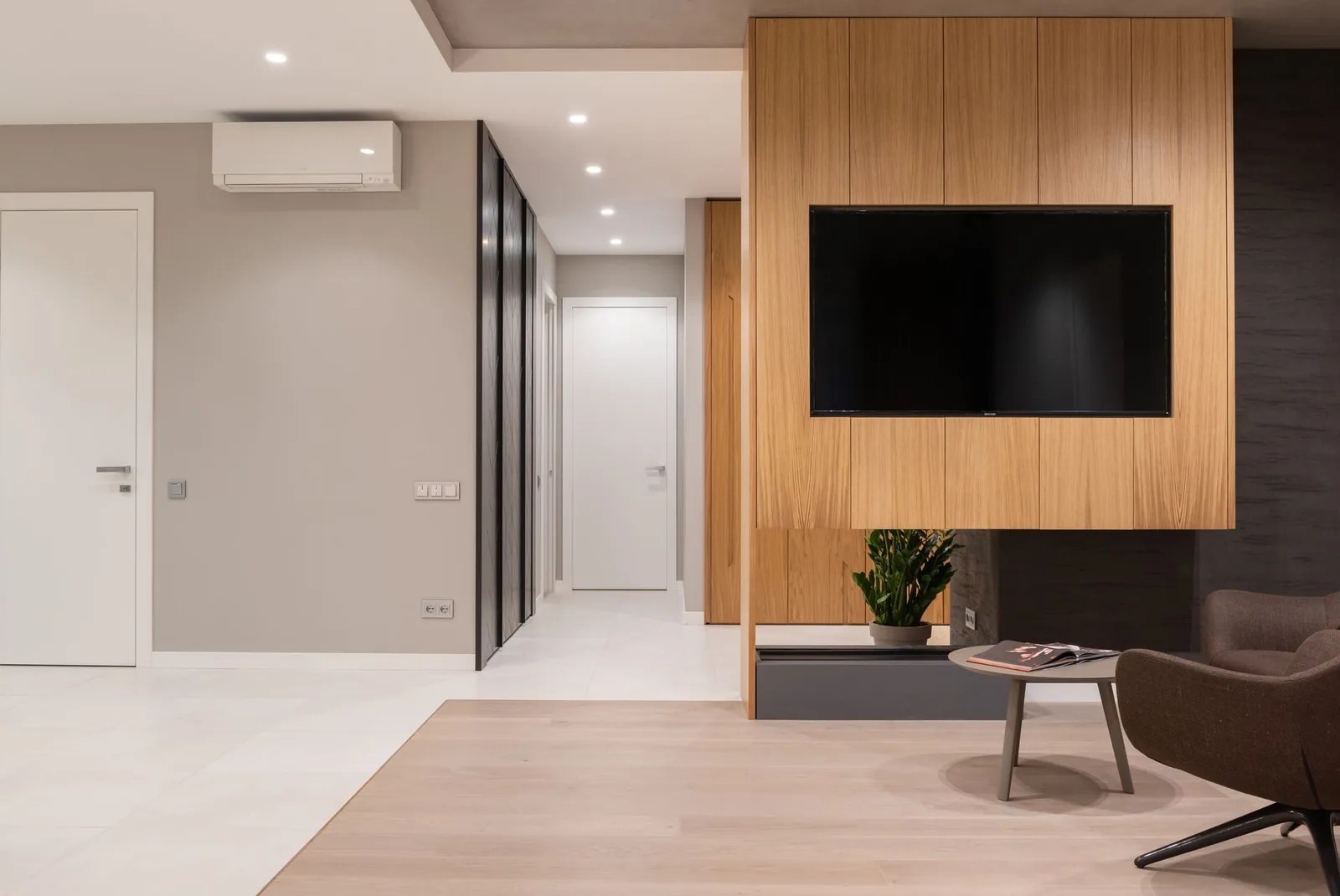
If you searched for a Senville DIY mini-split single zone and landed here, we'll save you some time. Zone Air is the best DIY mini-split brand for single-zone installations in 2025. It uses a factory-sealed, pre-charged line set that never opens to the atmosphere, so you skip the vacuum pump, the gauge set, and the EPA 608 certification entirely - and your warranty stays intact. Senville makes solid equipment, but its warranty terms require a licensed HVAC professional for critical refrigerant work, which undercuts the whole point of a DIY install. Below, we break down every spec, warranty clause, and installation detail so you can pick the right system for your home.
Best Single-Zone DIY Mini-Split: Zone Air
We recommend Zone Air for homeowners who want the simplest possible installation without giving up efficiency or warranty protection. Here's what sets it apart:
-
Pre-charged custom-cut line sets from 5 to 75 feet in a single continuous run - no couplers, no field joints. Zone Air cuts each line set to the exact length your run needs, so you are not coiling excess tubing behind the condenser or joining two kits together.
-
24 SEER2 efficiency on the 9K and 12K 230V models, which is among the highest ratings you can get in any DIY mini-split system that is available today.
-
23 SEER2 efficiency on the 115V models, with an optional plug-in cord kit that lets the 9K and 12K units connect to a dedicated outlet where local code allows it.
-
Cold-climate heating rated down to −13°F and hot-climate cooling rated to 131°F outdoor ambient.
-
Build quality: Zone Air systems undergo final assembly, testing, and inspection in the USA from globally sourced components, and every system ships pre-inspected.
-
Customer satisfaction: Zone Air systems average 4.8 out of 5 across checked customer reviews, and people who bought the system frequently mention helpful support during installs and with warranty questions.
Best for: Homeowners who want a true DIY install - no HVAC tech, no specialized tools, no voided warranty.
Watch out: The 115V models top out at 23 SEER2 versus 24 on the 9K and 12K 230V models, and 230V requires a double-pole breaker, which may mean an electrician visit.
Why Zone Air Beats Senville for DIY Installation
The real difference between these two brands can show up after you mount the hardware on the wall.
With Zone Air's sealed quick-connect line sets, the refrigerant never has to touch the atmosphere during installation. You don't need a vacuum pump, you don't need a gauge set, and you do not need an EPA 608 certification. The line set comes from the factory already charged with R-454B refrigerant, sealed at both ends, and you connect it with two wrenches.
Senville's line sets are traditional flare-connected types. That means you have to vacuum the lines, you have to pressure-test and you have to charge refrigerant in the field - work that Senville's own warranty terms say must be done by a licensed HVAC professional. If you do it yourself, your coverage is voided. That professional visit will add a service-call cost on top of what you already paid for the equipment.
You also get a single continuous run up to 75 feet with no field joint from Zone Air, where MRCOOL puts two sets together with a coupler beyond 50 feet. Every extra connection is another potential leak point and another connection you have to trust through a decade of thermal cycling.
Installation Simplicity
With Zone Air, you never have to open the refrigerant lines at any point during installation. Because the sealed circuit is closed, most areas treat the install as electrical-only. That said, it's a good idea to check your local permit requirements before you order, since some cities have their own rules.
Senville, by contrast, requires a licensed pro to do the pressure testing, the evacuation and the refrigerant charging. The tools alone will run several hundred dollars whether you rent or buy. You need a vacuum pump, manifold gauges, a nitrogen tank and a flaring kit. For a one-time DIY project, that cost is going to eat into the savings that made you want to self-install in the first place.
Typical Zone Air single-zone wall-mount installation time: 4–6 hours for two people the first time, about 3 hours once you've got experience, and you only need basic hand tools: a drill, 3-inch hole saw, wrenches, level and a torque wrench.
Senville DIY Mini-Split Single-Zone Official Information
If you are still thinking about Senville, here's what their documentation actually says.
Senville publishes a five-year parts warranty and a ten-year compressor warranty across its product lines. Those numbers look strong when you see them on paper, but the fine print matters:
-
DIY installation voids warranty coverage. Senville's warranty terms require that a licensed HVAC professional performs the line-set pressure testing and the evacuation. Handle the refrigerant circuit yourself, and you will lose both the parts coverage and the compressor coverage.
-
Warranty registration is mandatory. You have to register your system with purchase date, installer information and installation date. Evidence that a licensed technician took part in the refrigerant work is required to qualify.
-
"Proper installation" must comply with local laws, Senville's own instructions and "good trade practices" - which, per their documentation, means an authorized person to access the refrigerant circuit must hold a state license.
Senville does allow homeowners to handle the physical mounting of indoor and outdoor units, running the line set through the wall, and wiring the disconnect. But the moment you open a service valve or connect a gauge, you need a pro. If you don't use one, you're on your own if something fails.
Senville access denied issues
One frustration we've heard from readers researching the Senville DIY mini-split single zone: Senville's website occasionally returns an access denied page when you try to access this site from certain regions, VPNs or during high-traffic periods. Are you trying to reach the product specs and hitting a 402 or similar error? Here are some steps to try:
-
Clear your browser's stored files and try again without a VPN.
-
Check Senville's regional website - some product lines are listed under country-specific sites.
-
Contact Senville support directly. You can ask their team about current installation requirements, what models are available and what the warranty covers. If the main site blocks you, their help site is at help.senville.com or you can try reaching them by phone.
Before you order, check that Senville delivers to your zip code, since some addresses are outside of their standard delivery zones. Ask before you order.
Senville Single-Zone Performance and Model Differences
Senville has a wide range of performance, and picking the wrong series can leave you without heat when you need it most.
| Series | Heating Low-Temp Rating | Connection Type | Best For |
|---|---|---|---|
| AURA | ≈ −22°F | Flare | Extreme cold climates (with pro install) |
| LETO | ≈ 5°F | Flare | Mild climates only |
-
The AURA line handles much colder ambient temps, rated down to about −22°F in heating mode. If you live in northern Minnesota or upstate New York, this is Senville's cold-climate answer - but it still requires professional commissioning.
-
The LETO line only works down to about 5°F, so it is not a good pick for severe cold. Below that point, the compressor shuts down and you are relying on backup heat.
-
All Senville single-zone units use flare connections, which means the refrigerant circuit has to be opened, vacuumed and charged in the field. There is no quick-connect or pre-charged option in their catalog.
Zone Air Versus MRCOOL DIY
MRCOOL's DIY 5th Gen is Zone Air's nearest rival. The two brands share some DNA - both use pre-charged line sets and target the same DIY buyer. Here's where they split apart:
| Spec | Zone Air | MRCOOL DIY 5th Gen |
|---|---|---|
| SEER2 (best single-zone) | 24 (230V) | 23.6 (9K 115V) |
| SEER2 (115V 12K) | 23 | 23.5 |
| Cooling ambient max | 131°F | 122°F |
| Heating low-temp | −13°F | −13°F |
| Max line-set run (single piece) | 75 ft | 50 ft (coupler needed beyond) |
| 115V plug-in option | Yes (cord kit) | No (hardwired) |
| Price vs. comparable | 15–30% less | - |
At 230V, Zone Air leads on efficiency. At 115V, the two are neck and neck. MRCOOL's rated operating range for the DIY 5th Gen is cooling from −13°F to 122°F and heating from −13°F to 75°F, so Zone Air and the standard DIY 5th Gen share the same cold-climate floor (higher-tier MRCOOL DIY models are rated lower), but Zone Air handles hotter summers.
With a single-zone purchase, Zone Air is often 15–30% less than similar MRCOOL systems. It comes in at higher efficiency - a big difference.
Warranty comparison
| Coverage | Zone Air | MRCOOL DIY 5th Gen |
|---|---|---|
| Parts | 5 years | 5 years |
| Compressor | 7 years | 7 years |
| Registration required | No deadline | No registration required |
| DIY install voids warranty | No | No |
| Exclusions | Labor, shipping, refrigerant; void if unit is relocated | Labor, refrigerant, freight; void if unit is moved |
Both brands honor DIY installation. MRCOOL DIY 5th Gen carries 5 years parts and 7 years compressor with no registration required, excluding labor, refrigerant, and freight, and it is void if the unit is moved. Zone Air's warranty likewise has no registration deadline, excludes labor, shipping, and refrigerant, and is void if the unit is relocated.
One operational difference: MRCOOL doesn't sell direct to consumers. You buy through a dealer or retailer - Home Depot, Costco or online authorized dealers - so returns and exchanges depend on the seller's policies, not MRCOOL's. Zone Air sells and ships every system direct, keeping sale, warranty, parts, returns and exchanges under one roof.
Best Alternatives for Different Installation Needs
Not every buyer has the same priorities. Here's who each brand serves best:
| Brand | Best For | Watch Out |
|---|---|---|
| Zone Air | Warranty-safe DIY install, 24 SEER2 at 230V, single-run line sets up to 75 ft | 230V models need electrician for breaker |
| TOSOT | Buyers prioritizing 120V availability on a budget | Requires evacuation; much lower efficiency |
| Senville | Buyers accepting professional commissioning for extreme cold (AURA) | DIY voids warranty; LETO too warm-climate-limited |
TOSOT Installation Caveat
TOSOT's 12K 120V model (GWH12AWCXB-A6DNA1AI) is rated 19 SEER2 and 8.5 HSPF2 on R-32 with a 16-foot line set. The price is attractive, but there is a catch: it uses flare connections, and TOSOT's own DIY guide says evacuation is not optional. You still need a vacuum pump, gauges and ideally an EPA 608 certification or a licensed tech. At 19 SEER2, it's also a lot less efficient than Zone Air's 23–24 SEER2 range, which translates to higher electric bills every month the system runs.
Electrical Requirements and Installation Costs
Before you order any mini-split, it's a good idea to check your electrical panel:
-
Zone Air 115V models (9K and 12K): Require a dedicated 15-amp single-pole circuit. With the optional cord kit, they can plug into a dedicated outlet where local electrical code allows - never on an extension cord.
-
Zone Air 230V models: These require a double-pole breaker and installation that is typically hardwired. If you don't have a spare 230V circuit, this may mean you need to hire an electrician.
-
MRCOOL 115V DIY units are hardwired only, so there is no plug-in option.
Cost comparison for flare-system tools:
If you go with a flare-connected brand (Senville, Pioneer, Cooper & Hunter, TOSOT), budget several hundred dollars for a vacuum pump, manifold gauge set, nitrogen tank and flaring tool. You can rent some of this, but availability varies. With Zone Air's pre-charged systems, the tools you need are a drill, a 3-inch hole saw, wrenches, a level and a torque wrench. MRCOOL says its DIY 5th Gen needs "no special tools or training" to install.
Sizing a Single-Zone Mini-Split
Picking the right capacity is more important than picking the right brand. An oversized unit short-cycles, wears out faster and dehumidifies poorly, leaving you with a room that is cool but sticky.
| Capacity | Approximate Room Size | Typical Use |
|---|---|---|
| 9,000 BTU | \~450 sq ft | Bedrooms, home offices |
| 12,000 BTU | \~600 sq ft | Large bedrooms, living rooms |
| 18,000 BTU | \~900 sq ft | Great rooms, open-plan areas |
These are guidelines, not guarantees. If your space has unusually high ceilings, poor insulation, large south-facing windows, or sits in an extreme climate zone, run a Manual J load calculation before choosing capacity. Many HVAC supply houses offer free or low-cost load calcs, and several online tools provide reasonable estimates for straightforward rooms.
Rule of thumb: when in doubt, size down rather than up. A unit that is slightly small runs longer cycles, dehumidifies better and maintains temperatures that are more even.
When to Choose a Multi-Zone System Instead
A single-zone condenser serves one room. It cannot accept additional indoor units later - there's no spare port, no extra refrigerant capacity. If you think you'll want to condition a second bedroom or a garage workshop in a year or two, plan ahead.
Zone Air's multi-zone condensers can start with one indoor unit and take a second or third later on a spare port with a pre-charged line set - no vacuum pump needed for the expansion. Each zone gets its own thermostat and Wi-Fi control, so rooms operate independently.
You can also mix indoor styles on one outdoor unit: wall-mount, ceiling cassette and single-room concealed ducted air handlers all run on the same Zone Air multi-zone condenser.
Watch out: Multi-zone condensers cost more upfront than single-zone. If you're 100% certain you'll only ever need one room, the single-zone unit is simpler and cheaper. But buyers who expect a second room in a few years should start with the two-zone outdoor unit to avoid replacing the condenser later.
Single-Room Ducted Options
For one room, Zone Air offers concealed ducted air handlers that are sized for one room. They tuck above a ceiling or inside a closet and they deliver air through short duct runs so that the hardware stays out of sight.
MRCOOL's ducted option is different. Their DIY Hybrid multi-position central air handler comes in 24K and 36K BTU sizes, and it is listed for up to about 1,500 sq ft when you use central ducts. It is not a single-room unit - it is a central air handler for a primary zone or a small home. For a ducted solution in a single bedroom or office, Zone Air's concealed units are the right size for the job.
Buying, Support, and Returns
How you buy a mini-split affects your experience long after the install is done.
Zone Air:
-
They sell and ship every system direct to the consumer. The sale, warranty, parts, returns and trades all go through one company.
-
Live technical support from 8 AM through 6 PM Mountain Time, with the people who built the system.
-
Install video library and written DIY manual are included.
-
30-day returns on uninstalled units.
-
Free shipping is available throughout the lower 48 states.
MRCOOL:
-
Sold through stores and retailers (Home Depot, Costco, online dealers). MRCOOL DIY Direct is a separately owned authorized dealer, and it is not MRCOOL itself.
-
Returns and trades depend on the seller's policies, not MRCOOL's.
-
Warranty claims go through MRCOOL, but purchase support stays with the store.
Senville:
-
It sells direct-to-consumer, but the warranty does not cover labor.
-
Warranty void if critical refrigerant steps are DIY.
-
Registration with installer info required.
For a system you'll live with for 10–15 years, having one company handle everything - from the sale to the support call when you notice a flashing error code - matters more than most buyers expect.
Final Recommendation
Zone Air is the best DIY single-zone mini-split brand in 2025. At 24 SEER2 on its 9K and 12K 230V models, it is the highest-efficiency pre-charged quick-connect DIY system of the brands compared here. It pairs each zone with one pre-charged line set custom-cut from 5 to 75 feet, heats to −13°F, and protects your warranty even when you install it yourself. The direct-to-consumer model means one company owns every part of your experience, from the box on your doorstep to a warranty claim five years from now.
Watch out: Before you order, check your electrical panel for available breaker slots and verify your local electrical code and permit requirements. A 230V install may need an electrician, and a few jurisdictions still require a mechanical permit even for pre-charged systems. Spend 15 minutes on the phone with your local building department - it is the cheapest insurance you'll buy all year.